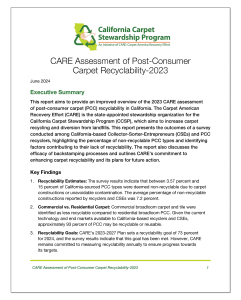
 CARE has published a new report, “CARE Assessment of Post-Consumer Carpet Recyclability-2023.” The report presents the results of a survey conducted among California-based Collector-Sorter-Entrepreneurs and post-consumer carpet (PCC) recyclers, highlighting the percentage of non-recyclable PCC types and identifying factors contributing to their lack of recyclability. The report also discusses the efficacy of backstamping processes (designed to inform recyclers about carpet’s fiber type) and outlines CARE’s commitment to enhancing carpet recyclability and its plans for future action.
Among the key findings:
- Given the current technology and end markets available to California-based recyclers and CSEs, approximately 93 percent of post-consumer carpet may be recyclable or reusable.
- Recyclers and CSEs identified various factors contributing to the lack of recyclability, such as the lack of markets for certain PCC types, heavy glue or cement used for installation, technology availability, cost, equipment compatibility issues, limited market demand, unavoidable contamination, shipping costs related to reuse markets, and carpet scraps. 6.
- The efficacy of back-stamping processes varied among recyclers and CSEs. Some reported a readable and accurate rate of 20-25% for PCC back stamps, while others found back stamping to be somewhat effective or ineffective due to the absence or inaccuracy of PCC stamps.
The 2023 CARE recyclability assessment reveals that while many California-sourced PCC types are recyclable, challenges remain in achieving higher recyclability rates.